
The proper help can be a benefit - age pension
About two-thirds of Australians are entitled to at least a partial age pension (i), so most of us need to understand how it works and determine what role we want it to play in our retirement plan.

The age pension provides key benefits to retirees. It pays an income stream until death that is adjusted for inflation, providing a bulwark against poverty and higher prices in our later years.
Even though age pension benefits may sometimes be quite small, the fact that they continue until death can help manage the risk that you may live longer than planned for in retirement. For example, a male/female couple both aged 67 today has a 50 per cent chance that at least one of the couple makes it to age 90 and a 5 per cent (1 in 20) chance that one of them makes it to age 99 (ii).
Because the age pension is means tested and personal situations and goals vary so much, this is one of the occasions when it makes sense to consider using a financial advisor to help understand the rules and factor the age pension into your broader retirement financial plan.
To decide how much age pension you are entitled to receive, the government considers your assets and your income. The level of pension received is based on which of those means tests produces the lower benefit.
On a basic level, the lower your assets and income, the more age pension you will be entitled to as its role as a safety net kicks in up to the maximum amount of $843.60 a fortnight for a single pensioner and $635.90 each for a couple, as at March 2019.
A financial advisor experienced in the interaction of the social security and superannuation systems can help you understand how these rules work and in particular the key break points where benefits reduce.
As you can see from this chart, the benefits drop off quite steeply at certain asset levels.
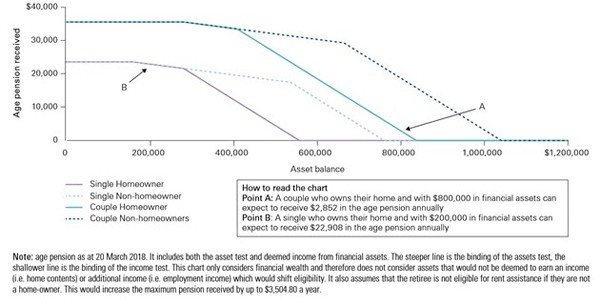
Understanding the impact of wealth on the age pension received
An advisor can also help you make decisions about how these breakpoints interact with your financial goals.
For example, consider the couple at Point A in the chart. If they start drawing down their assets to increase their annual spending or make a one-off purchase, they will also increase their yearly age pension benefit. This might be a wise move for some couples but not for others. Let's say this couple had identified leaving money to their children or setting aside funds for aged care as a financial goal. In those cases, the couple might do best to preserve and possibly grow, rather than spend, their assets, to achieve the goal.
Financial advisors can also guide you through other key considerations, including:
Rules on the treatment of annuities for means testing
Pension loan schemes to increase age pension using home equity
Links between age pension and related benefits, such as the Commonwealth Seniors Health Card
To learn more on the age pension and on creating financial security in retirement, check out our latest research on the topic.
i According to the Australian Institute for Health and Welfare
ii "The role of the Age Pension in your Retirement Plan," p. 3.
Robin Bowerman
Head of Corporate Affairs at Vanguard.
09 April 2019
Latest eNewsletters
Hot Issues
- Five steps towards a more confident retirement
- Financial literacy in Australia: Where we're improving (and falling behind)
- CSLR levy on SMSFs unfair
- SMSF pension shortfall – when can trustees self-assess?
- How to turn your annual SMSF investment strategy review into a genuine analytical exercise
- Super viewed as mortgage solution
- Tokenisation to change SMSF landscape
- Check out the largest castles by country
- ATO’s LRBA data significantly less than industry figures
- New deeming thresholds could deliver small part age pension
- Can I still get the Age Pension if my super is healthy?
- New to SMSFs? Start preparing for your first SAR lodgment
- Contribution splitting now more valuable
- Six ways Gen X can build retirement savings
- How to maximise the impact of your inheritance
- How Our Diets have Changed.
- Adequate retirement savings misjudged
- The SBSCH will close from 1 July 2026
- Complications of maintaining two cost bases in Div 296
- What the Payday Super changes mean for your retirement
- investment and economic outlook 2026
- Rules apply to gifting in superannuation
- Record SMSF growth driven by digital access
- The evolution of the world's languages
Article archive
- April - June 2026
- January - March 2026
- October - December 2025
- July - September 2025
- April - June 2025
- January - March 2025
- October - December 2024
- July - September 2024
- April - June 2024
- January - March 2024
- October - December 2023
- July - September 2023
- April - June 2023
- January - March 2023
- October - December 2022